A few months ago my girlfriend and I took a trip up to Connecticut for no real reason other than to get away for a few days. My girlfriend went to university in Hartford, Connecticut but I had never been and was excited about having the opportunity for a new experience. We stayed at a beach house her friend was renting in the off season. The weather was very cold, which was actually a benefit to ward off the summer tourists from the restaurants and beaches. Overall the trip was very relaxing. I spent the days exploring the town, walking the beaches, and reading the local news paper. All of this is what I was expecting from the trip.
What I wasn't expecting was the tremendous amount of artistic inspiration I received, which I entirely owe it all to my girlfriend. On about the third day of the trip she was insistent that we find something to do other that browse around or take another walk around the community. So she spent the better part of the morning browsing the Internet and the newspaper looking for something to do. What she found was an impressionist art museum in Old Lyme, Connecticut called the Florence Griswold Museum. Florence Griswold was a woman who inherited a house from her family and decided she'd rent it to artists to subsidies the cost of this inheritance. More and more artists began to stay at the home due to its location ( being near both Boston and New York City ) and its beautiful landscapes. Eventually it became somewhat of an artist colony that had a heavy influence on Impressionism in the United States. I've always had an interest in impressionist painting. Primarily because every painting course I've taken since the age of 13 till today instructors have compared my work to Impressionism, so I have a personal connection with the style.
The museum had some great works of art from artists, who stayed at the Griswold mansion, including Henry Ward Ranger, Willard Metcalf, Matilda Browne, and William Chadwick. The Griswold mansion was restored to give a glimpse of things such as what a typical room looked like, the dinning room where all the artists had dinner together and how Ms. Florence's room would have appeared. This glimpse into their lives is what struck me as most inspirational. For one the artists painted everything in the house. Their canvases extended to everything from the panels of the doors and walls to pieces of furniture. Many of these works told a story about the individual in that space or a story about an encounter while staying at the house.
One of my favorite works was a panoramic landscape painted on the fireplace mantle in the dining room, where all the artists would have dinner together. The scene contained about a dozen people running through a field. The figures included a shirtless man painting, one guiding a cow, others holding bottles of booze, and people hiding behind rocks. It looked funny, almost like a cartoon. One of the employees at the mansion explained the story behind the work and that all the figures were artists from the house. They used this piece to poke fun at one another. The woman, who worked at the house, went on to explain humorous stories behind several other of the works painted on the doors and walls. The artists used several of these paintings to talk to one another and tell inside jokes while making great works of art.
When returning to Baltimore after the relaxing mini vacation I was given the opportunity to generate some design work that uses humor and story telling, much like the artists at the Florence Griswold artists' colony. A friend of mine had a birthday coming up and I wanted to send around an invitation inviting people to a happy hour celebrating the occasion. I wanted to produce something fun that would be personal to him but that others would still find fun and funny. My friend is Russian and growing up we had nicknamed him The Russian Bear because of the way he would shout when making a play or showing frustration in a sporting event. I included aspects of his background and his nickname into the emailer and short animation, which I've included below. Putting the design together was a lot of fun and I feel that's what made the final piece so successful.
Click the image to see the animation or watch in the embedded youtube video below.
Showing posts with label design. Show all posts
Tuesday, May 24, 2011
Wednesday, September 8, 2010
Motion Graphics
I remember being a kid in elementary school after school care program and one of my favorite activities they would do with us was to take a full pack of index cards and a binder clip and draw card by card to produce a flip book. Like every kid I loved cartoons but I was really fascinated in how they were produced. I remember being very fascinated by the show Samurai Jack because of the elaborate hand painted backgrounds of the late night cartoon. In older age I remember getting excited about MTV's idents and the pop up graphics on VH1's pop up videos.
Learning motion graphics has been very natural so far due to my work in flash. Currently I'm working my way through over 100 tutorials on the videocopilot.net website in order to master the tools of the trade. Hopefully soon you'll see some original motion graphic projects coming from me.
But until then please enjoy this college project of mine using a scanner and still images mixed with Photoshop effects in order to produce stop motion animation. I used pieces from a broken VCR and images/scans of myself to create tension between man and machine. It's loosely supposed to be a narrative about robots. Could androids exist? Maybe, maybe not but it was a lot of fun to do and the process matches the concept (a little bit of hand work and a little bit of computer).
Tuesday, April 20, 2010
The Mark
A mark is one of the most powerful modes of expression. An individual conjures up a thought, which travels through their limbs to a tool ending in a stroke on the surface with a direct connection to the source of the thought. These marks of expression are then taken in by others and the thought has a direct connection from one individuals mind to another.
Many artist have used and explored the limits of human expression through the process of making stokes and marks. A prime example of one such artist is Cy Twombly. Twombly has displayed works of art that some would see as pure scribbles. But there is no denying these illegible scribbles give a sense of emotional expression extending from Twombly himself.
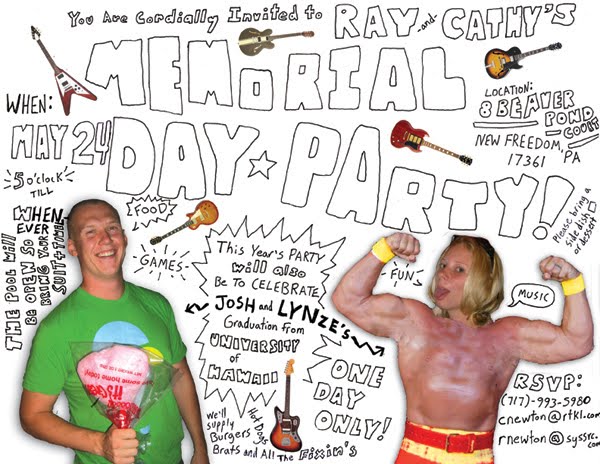
Readability is not an issue when it comes to the works of fine artists. Designers need to worry about the messages being clear, words readable, and delivering information to the most people. Printing presses, cameras and computers have added clarity to the messages to they’re easily interpreted. The problem with these tools and their method of clarity is often times the human connection, which engages the user to view the work in the first place, is lost. The individual expression is gone and the messages blend in with one another because they have no unique personality.
So what’s the solution? Is there a balance between retaining the hand made mark and still effectively delivering the message? The works below are some of my attempts. I tried to produce these works quickly and a spontaneously without being overly concerned of legibility. The computer was used to recreate the works and send them to the masses. The result, people noticed the works and so engaged that they took the time to read every word in the piece.
Subscribe to:
Posts (Atom)